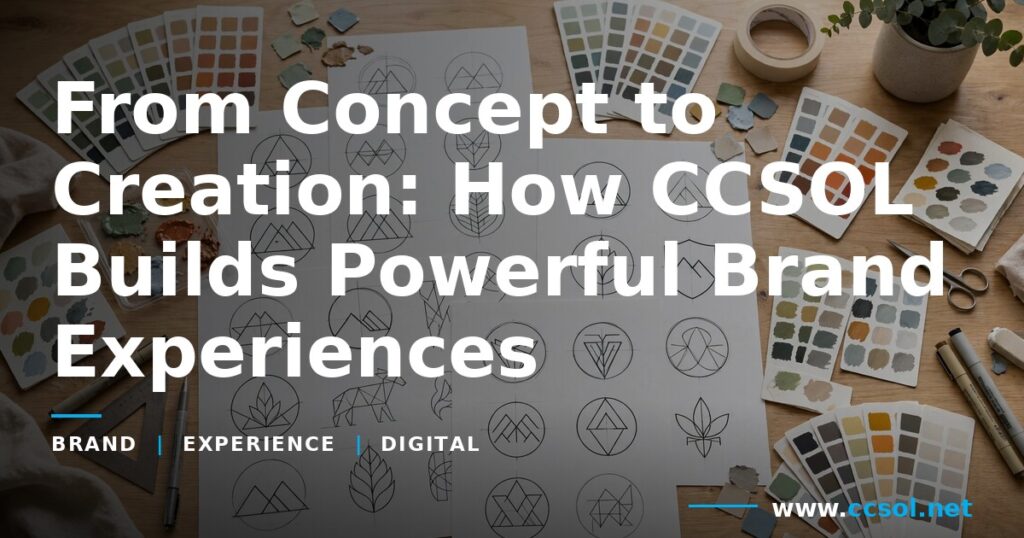
A strong brand experience does not happen by accident. It is the result of deliberate choices made at every stage, from the first conversation about a business to the smallest detail of its website.
Behind every memorable digital presence is a process: understanding the idea, shaping the concept, building the experience, and continuously improving it. Skipping a stage usually shows up later, as a message that confuses people or a design that looks good but says nothing.
At CCSOL, creative work begins with curiosity and develops through collaboration. We ask questions first, and we design second, because a brand experience that is not grounded in the business it represents will not hold up.
Step One: Understand the Brand
Before creating visuals, we need to understand the business. A logo, a color palette, or a homepage cannot carry a brand that has not been understood first.
What does it offer? Who does it serve? What problem does it solve? What makes it different? What should customers remember? These questions sound simple, but answering them honestly takes real discussion.
The answers create the foundation for everything that follows. They decide what the brand should say, how it should look, and where it should show up, so later decisions become easier rather than harder.
Step Two: Find the Central Idea
Every strong brand experience needs a clear central idea. Without one, a brand produces disconnected pieces: a website that says one thing, a campaign that says another, and social posts that say nothing at all.
This idea becomes the thread connecting the visual identity, website, messaging, campaigns, and customer experience. It is the sentence the whole team can return to when a decision is difficult.
A clear idea helps teams make better creative decisions because everyone understands what they are building toward. It also helps customers, because a brand with one clear idea is far easier to remember than a brand with ten half-formed ones.
Step Three: Build the Visual Language
Once the concept is clear, we translate it into a visual language. This is where the central idea becomes something people can see and feel.
Typography, colors, imagery, composition, icons, motion, and interface patterns all have a role. Each choice should support the same idea, so the brand feels coherent whether someone sees an ad, a website, or a product screen.
The objective is not simply to make the brand attractive. It is to make the brand recognizable and understandable, so people can tell at a glance who this is and what it stands for.
Step Four: Turn Design Into Experience
A brand is experienced, not just viewed. People do not only look at a brand; they click through it, search it, buy from it, and contact it, and each of those moments shapes what they think.
That is why websites and digital products need to consider navigation, interaction, speed, accessibility, content, and user expectations alongside visual design. A beautiful page that is hard to use still disappoints, and a fast page that confuses still loses people.
The creative experience becomes stronger when design and technology work together from the beginning. When designers understand what is technically possible and developers understand what the design is trying to achieve, the result feels effortless rather than assembled.
Step Five: Collaborate Across Disciplines
Creative projects become stronger when designers, developers, marketers, strategists, and business teams work together. Each discipline sees something the others miss, and the work improves when those views meet early.
Different perspectives reveal different possibilities. A strategist may spot a message the design overlooks; a developer may suggest an interaction the design had not considered; a marketer may know which words customers actually use.
At CCSOL, collaboration helps turn creative concepts into practical digital solutions. It also keeps projects honest, because an idea has to survive contact with real constraints: budgets, timelines, platforms, and the people who will use the result.
Step Six: Refine Through Feedback
The first version is rarely the final version. The first version is a starting point: good enough to react to, and honest enough to reveal what needs work.
Feedback helps reveal what is working, what is unclear, and what can be improved. The most useful feedback often comes from the people who will actually use the experience, not only from the team that built it.
Refinement is not a sign that an idea failed. It is part of the creative process. The same discipline runs through the lessons from building brands: test ideas against alternatives, listen before deciding, and let the work improve through revision.
Technology Expands the Canvas
Today, creative teams have more tools than ever before. AI, automation, advanced interfaces, analytics, and modern development technologies allow ideas to become interactive and intelligent experiences.
The opportunity is exciting, but technology should always support the experience rather than distract from it. This is the same balance explored in where creativity meets technology: new tools are valuable when they serve a clear idea, and they become noise when they become the idea.
Creating Something People Can Believe In
The strongest brands communicate confidence because every part of their experience feels intentional. Nothing feels accidental, and nothing contradicts anything else.
From the first impression to the smallest interaction, consistency and purpose build credibility. Customers may not notice every detail, but they notice when details disagree, and they trust brands whose details agree.
That is the standard I want us to continue pursuing at CCSOL, and it connects directly to creativity in business growth and transformation: when creativity is treated as a business discipline rather than decoration, it shapes how a company communicates, serves customers, and grows.
From Concept to Creation
For me, the creative journey can be summarized simply:
Understand the idea. Shape the vision. Design the experience. Build the solution. Refine the result.
That is how concepts become experiences — and experiences become brands people remember.
About Ali Iftikhar
Ali Iftikhar is the Creative Head and Co-Founder of CCSOL, leading creative direction and contributing to branding, UI/UX, digital experiences, and technology-focused creative projects.
Need Assistance? Let’s Build Something Exceptional. 🚀
Have a project, a business idea, or a digital challenge? CCSOL – Creative Concepts & Solutions provides innovative web, digital, and IT solutions that help businesses build a stronger online presence, improve performance, and achieve measurable growth.
📞 +923272500008
🌐 www.ccsol.net
CCSOL – Creative Concepts & Solutions
🚀 Empowering Businesses with Innovative IT Solutions Since 2010